
Last year, on a trip to Portland, I found out about an incredible printmaking workshop at a community studio fifteen minutes from where I was staying. I found out three days after it happened.
I would have gone. I had wanted to learn screen printing for years, and the studio was exactly the kind of place I want to support: volunteer-run and focused on making creative practice accessible. I just didn't know it was happening.
And I wasn't hard to reach. I follow forty-odd venues and organizations on Instagram. I belong to neighborhood Facebook groups where I pretend to care about parking disputes just to stay in the loop. In marketing speak, I was a warm lead. High intent. Ready to convert.
I still missed a free workshop fifteen minutes away. If I couldn't find it, what chance did anyone else have?
Here's the thing I keep coming back to. Homes existed before Zillow. Restaurants existed before Yelp. Places existed before digital maps. Nothing about the world changed. Someone gave the information structure. Nobody has done that for local events.
This wasn't a marketing failure
That workshop helped me name a pattern I had been noticing for years. Extraordinary local organizations are doing important work, and the information about that work is remarkably hard to find.
It isn't for lack of trying. Studios, galleries, libraries, theaters, farms, breweries, and neighborhood organizations publish constantly. They update websites, post to Instagram and Facebook, send newsletters, make flyers, and maintain calendars when someone has time.
The usual advice is to post more, make better videos, improve the hashtags, figure out Reels, and be authentic on TikTok. If I hear "leverage user-generated content" one more time, I may throw a ceramic mug at someone.
The problem isn't effort. Local organizations are publishing into systems built to display information, not to help people find it when they need it.
The event is real. It just isn't findable.
A single workshop might appear as a poster in a window, an Instagram caption, a Facebook event, a line in a newsletter, a listing on the studio's website, and an entry in a Google Calendar. All of those references describe the same real thing happening at the same place and time.
But computers don't necessarily know that. One source abbreviates the studio's name. Another uses a slightly different address. One calls it "Intro to Printmaking," while another calls it "Saturday Screen Printing." To a person, these are obviously the same workshop. To a machine, they can look like six unrelated facts.
This is the part I can't unsee, partly because I'm a nerd, but mostly because structuring messy information is what I have done for most of my career.
Think about what structure actually did. A house became an address, a price, a number of bedrooms, a school district, and a point on a map. Once the information had structure, people could search it, sort it, compare it, and discover things they had never heard of.
Local events have never received that treatment consistently across the web. The information exists, but it is scattered across calendars, websites, newsletters, social posts, flyers, and ticketing systems. What's missing is the structure connecting it.
And to the person who would have gone, unfindable might as well mean it never happened.
What we're building
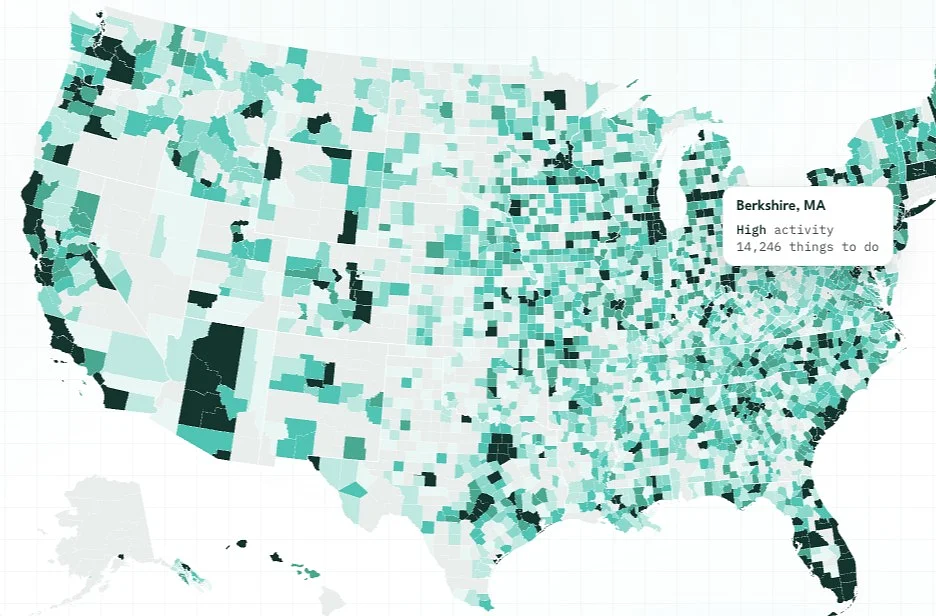
Daisy does two things: we map things to do, and we graph how they connect. Mapping means finding the calendars and events already scattered across the web and keeping track of what is happening, where, and when. Graphing means understanding the relationships underneath them.
That printmaking workshop belongs to the studio that published it. It also belongs to its neighborhood, to arts and culture, to a search for printmaking, and to a calendar of things happening that weekend. Daisy resolves the scattered references into one living record, preserves where the information came from, and connects the event to the places and calendars where it belongs.
The map finds what is happening. The graph makes it useful.
The studio should not have to recreate the workshop in ten different places. It should publish once. The event should remain theirs and continue to point back to them. The infrastructure should help it travel.
That is what was missing in Portland. The workshop had probably been published more than once, but nothing connected those scattered references to the person fifteen minutes away looking for exactly that kind of thing.
Why the graph matters
Helping someone find one workshop is useful. But once enough events are mapped and connected, something larger starts to appear. One trivia night is just one trivia night. Thousands of workshops, concerts, markets, readings, classes, and gatherings start to show how a place actually works. Where are people gathering? Which neighborhoods are active? What is a community investing in? The same structure that helps someone find a printmaking workshop can help a community understand its own cultural and economic life.
None of this should require every studio, library, theater, farm, or neighborhood organization to become a content machine. You shouldn't have to be good at Instagram to build a community space. You should have to create something people care about and publish the information once. Your events should remain yours. They should point back to you. And you shouldn't have to pay a toll just to become findable.
Daisy maps what is happening and graphs how it connects. The infrastructure should do the rest.