
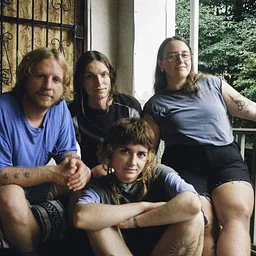
Sadurn
From publicly posted calendar Checked 4 hours ago
About this event
One of 36 upcoming events at Englert Theatre, and 103 across Iowa City.
Doors Open 8:00 PM Event Starts 9:00 PM $18.00 - $25.00 + taxes + fees Ticket Options $20.00 + Taxes+ Fees – General Admission – Advanced $25.00 + Taxes+ Fees – General Admission – Day of Show $18.00 + Taxes – General Admission – Student For off-site events, check-in is handled digitally or via guest list at the door. Please select E-ticket Delivery ($0.00) at checkout to avoid Will Call fees. Learn more about our fees HERE Many songwriters will tell you that music is an outlet, a way of processing the material of their lives. For whatever alchemical reason, music can sometimes express what words alone cannot. This was true for G DeGroot of Sadurn—until it wasn’t. Cut off from their ability to sing just as their music had begun to reach people, DeGroot had to find new ways to heal. It’s from this emotional and spiritual journey that Sadurn’s sophomore album The Underworld emerged—a collection of songs that is heartrendingly personal and instantly relatable, a document of hard-earned catharsis that somehow feels at once grounded and miraculous. Sadurn began in 2017 as a solo project for G DeGroot, and from the start their approach to songwriting was informed more by emotional intuition than any kind of real ambitions to be heard. “I discovered songwriting as an outlet for processing my reality,” they explain. “A lot of times when something is hard to say, it flows more easily in songwriting. It’s a place where you can circle back to your own truth.” After moving to Philadelphia, DeGroot was joined by guitarist Jon Cox, drummer Amelia Swain, and bassist Tabitha Ahnert; the group recorded Sadurn’s debut album, Radiator. After a cold email unexpectedly caught the attention of Run For Cover Records, the album was released in 2022 and despite Sadurn’s modest beginnings Radiator immediately connected with listeners and was met with critical acclaim. It was an exciting and often daunting position to be in: suddenly this personal outlet had an enthusiastic audience. “Right after we finished Radiator I already had new songs, but the idea that now there was some kind of expectation did change things in a negative way for me. So much of my sense of self had become tied up in the band, I got kind of swept up in the pressure of these internalized ideas about what’s going to be good for you or your life,” DeGroot says. “I think culturally everyone is trained to just follow the success machine, and even as musicians or artists we don’t always question that–you think you need to chase the momentum ‘cause it’s ‘your dream.’” The strain of following up a well-received debut isn’t entirely uncommon among musicians, but for DeGroot it wasn’t simply a matter of wanting to make LP2—it became a question of whether or not they could physically do it. The pressure around the band was one thing, but amidst it all, DeGroot was also going through a very challenging breakup. “All of this stuff led to medical fallout for me,” they explain. “I was having chronic pain, problems with my voice, gut issues—it felt so urgent to try and keep things going, but my body was saying no.” The band was determined to share their new material in spite of these challenges, and finally began recording in January 2024. “It felt like we were already late,” DeGroot says. “But we did the same thing as with Radiator–we rented a house in the Poconos with our friend Heather [Jones] recording so that we could really drop in with each other and relax into the creative process.” Since the release of Radiator, Sadurn had toured heavily and their development as a live unit was now paying off in the studio: DeGroot’s songwriting had become tailored to a full band, the pedal steel that was a highlight of their live show was now lending itself to the recordings, and the band had a well-earned, expressive cohesion in their playing. The sessions were fruitful and Sadurn planned to finish recording vocals in a future session, but then issues with DeGroot’s voice cropped up again. The band attempted a short tour while waiting to reschedule recording time. “By the end of that week I could hardly talk, let alone sing,” DeGroot says. “That lasted about eight months.” Things had reached a breaking point, and something was telling them that it was time to go. “I started trying a combination of vocal coaching and somatic therapy, and was making progress, but I realized I needed to leave Philly,” DeGroot explains. “I left without really knowing where I was gonna go. I set up some work exchanges and just put the album down. I let go of the idea that I was overdue on the record and set aside the urgency, and I think that released me. I basically lived on the road for a year, and that was when my voice started to heal.” As DeGroot slowly regained their ability to sing, they found some mental clarity along with it. They began cautiously playing intimate solo performances in living rooms and reconnected with performing music. Eventually they returned to Philadelphia to finish