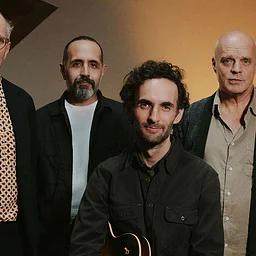
In the waning days of 2024, Julian Lage began what he calls a writing sprint. Lage has long been prolific: In the three decades since the documentary Jules at Eight identified him as a prodigy, Lage has made a dozen records with his own bands and duos, and three times that many with leading lights of his artistic orbit, like John Zorn, Gary Burton, and Charles Lloyd. But Lage was preparing for a four-day residency at SFJAZZ, plus the premiere of a new quartet of old collaborators and friends who had strangely never recorded together: Lage with steadfast bassist Jorge Roeder, dynamic drummer Kenny Wollesen, and vaunted keyboardist John Medeski. As he thought about their qualities as players and hypothesized about how they might interact, he set a timer for 20 minutes, wrote a tune, recorded it once, and then began again. Lage called one particular tune he loved during that sprint, “Storyville.” It’s quick, flickering riff felt like an invitation for conversation, exactly the kind of thing he hopes to find in such a sprint. “My dream with composing, really, is to have something to talk about once we’re together,” he says. “It’s not the end-all, be-all.” Hearing what the quartet created with the piece in the studio is like watching a pot of water boil and observing not the chaos but the order, the way every molecule is pushing against the other with purpose. That is the spirit of Scenes from Above, Lage’s second full-length album with the producer Joe Henry and his first with this striking quartet. Where 2024’s Speak to Me was Lage’s grand statement as an improvising bandleader capable of helming a relatively large ensemble through a diverse set of tunes, Scenes from Above is about being a band member himself, about Lage exploring the tunes he has written with a crew he has built with that entirely in mind. Its nine tracks frame a brilliantly open experience, with four astounding players giving and taking space in equal measure as they explore these songs in one space, in real time. “Neither of us were interested in making Speak to Me II. That record has its own character, and there’s a great liberation in that,” says Henry. “That was an idea that exists, and we don’t have to babysit it any longer.” After his assorted writing sprints, Lage had already whittled down the possibilities to maybe 50 pieces from perhaps twice that many. He began sending selections to Henry, and they talked about four or five that felt like essential pieces of this frame. Then they wondered about how they might add color and motion to that picture, less about what was missing and more about what felt important for this band to emphasize. Also, Lage was in a deep period of thinking about what he calls folkloric music, from the songs of Susana Baca and early calypso numbers to the American blues and Béla Bartók’s integration of Romanian and Hungarian tunes into his own work. His writing reflected those touchstones. And as the two-day session at New York’s Sear Sound ...
The Epstein Family Amphitheater is a state-of-the-art performance venue in the heart of UC San Diego.