
Jerome Witkin – Epic
From publicly posted calendar Checked 2 days ago
About this event
One of 1 upcoming event at Jack Rutberg Fine Arts, and 3,838 across Los Angeles.
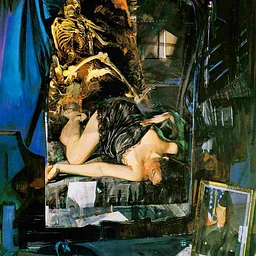
November 1 – December 24, 2026 Opening Reception Sunday, November 1, 2026 3:00 – 6:00 p.m. Pasadena, CA – Jack Rutberg Fine Arts will present a rare exhibition of one of America’s most highly regarded figurative painters in the much-anticipated exhibition Jerome Witkin – Epic. The exhibition opens Sunday, November 1, 2026 with a preview reception from 3:00 to 6:00 pm. Spanning several decades, the exhibition includes major works – some previously only known to curators and collectors from published books, since they’ve resided in private collections for decades, now exhibited for the first time since the early 1960s. At a time of renewed interest in figurative painting, Jerome Witkin’s art stands apart from other contemporary narrative artists. Jerome Witkin’s tour-de-force painterly works evoke every descriptive detail, texture and perspective in his complex narratives, yet his painting technique is more akin to the gestures of an abstract expressionist. With painterly bravura, his narratives are filmic and evocative, rather than illustrative. Jerome Witkin’s work was last viewed in Los Angeles twelve years ago in an historic tandem exhibition with his estranged identical twin brother, photographer Joel Peter Witkin. The exhibition, organized by Jack Rutberg gallery, prompted an expanded museum exhibition in Mexico City, two documentary films, two exhibition publications and more than a dozen reviews. First introduced to Los Angeles audiences by Jack Rutberg Fine Arts in 1995, the Los Angeles Times cited Witkin’s paintings as “a breakthrough in post-Cold-War art.” National art publications were no less effusive, noting Witkin’s “technique, draftsmanship, and emotionally loaded narration.” That exhibition was a two-venue presentation with Leband Gallery at Loyola Marymount University. That traveling museum show was too large to be shown in its entirety in the university’s gallery, and in spite of splitting the exhibition, it broke LMU’s attendance record. In the current exhibition, Jerome Witkin – Epic at the Jack Rutberg Gallery, the range of the artist’s virtuosity will be evident through large works that, in a single frame, evoke a narrative and painterly complexity few artists would attempt. Equally evocative are a group of small paintings measuring only 12 inches, while ostensibly simple, are equally evocative. Drawings in the exhibition, with an economy of line, are equally disarming, be they of urban scenes or those of figures. A group of small portraits are significant in the exhibition, as even in his largest tableaux, figures are always painted from life – each uniquely revealing. The individuality of these figures is evident in Witkin’s dramatic scenes. His large iconic painting, Her Dream, evokes an intriguing scenario, but leaves questions for the viewer, as do other poignant paintings in the exhibition, The Silence and The Circus. Even in a masterpiece – a double self-portrait titled, Painter’s Crossing: To the Passions of Rembrandt, Witkin weaves a complex narrative requiring multiple viewings to be discovered – remarkable enough, but this large painting with near photo-realist passages, further astounds with a close-up view as these passages dissolve into total abstraction. While Witkin’s paintings are rarely seen in person, critics and curators who have engaged his works have been effusive, not only for his skill but also for having interrogated the most profound events of our times with empathy that, as great paintings in history prove, can mediate those subjects that otherwise would be indescribable. This is exampled by Witkin’s 9/11, painted immediately following that fateful event, which is included in this current exhibition. Witkin has drawn comparisons to giants of art history. Among the legions of critics and historians, Kenneth Baker, the late author and critic of the San Francisco Chronicle wrote: “Jerome Witkin is a painter of psychological and moral allegories who can draw like Ingres… in combining stage management of complex compositions, and inch-to-inch paint handling, Witkin’s only peer is Lucian Freud;” with Donald Kuspit citing Witkin’s works as “dreams in the grand visionary manner of the Old Masters… painted with the rhapsodic abandon of pure sensation . . . unequivocal masterpieces.” Jerome Witkin was born in Brooklyn in 1939 and was early recognized in New York for his talents as a painter and draftsman at a time when figurative painting had largely fallen from favor in both the popular consciousness and academic circles. However, his talent soon earned acclaim and prizes, thrusting the young artist into the company of Willem de Kooning, Mark Rothko, George Grosz, Giorgio Morandi, Alice Neel, Ben Shahn, and other important artists of the period. He is a recipient of many prizes, including two Ford Foundation Grants, a Guggenheim and a Pulitzer Fellowship and has elicited a cult following among many significant artists. Witkin retired from teaching at Syracus