
Remaking Revolution: History in Popular Culture
From publicly posted calendar Checked 2 days ago
About this event
One of 11 upcoming events at Williams Research Center, and 812 across New Orleans.
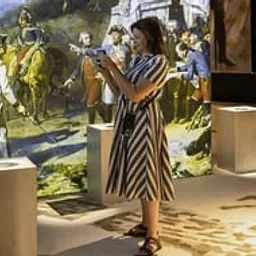
Williams Research Center, 410 Chartres Street Free admission, registration required Join us for an exploration of how revolutionary ideas have been represented and reinterpreted in popular culture. Expert speakers will examine how film, music, video games, and media continually reshape our understanding of revolution. This program will highlight the global influence of the Declaration of Independence, the role of songs, rumors, and dissent in colonial Louisiana, and the Haitian Revolution as portrayed in films and popular video games like Assassin’s Creed IV: Black Flag. Through talks and multimedia demonstrations these stories will be vividly brought to life, connecting past events with contemporary cultural interpretations. This event is presented in conjunction with American Revolution: The Augmented Exhibition, on view until January 17, 2027. Admission is free with registration required. An optional box lunch catered by Gracious Bakery is available for purchase during registration. Daniel Hammer, HNOC president and CEO 11 a.m. The Living Declaration For more than 250 years the principles of the Declaration of Independence—natural rights, equality, and the consent of the governed as the source of all legitimate power—have shaped our national history and spurred democratic aspirations around the world. Historian and former presidential speechwriter Ted Widmer joins us to talk about his new book, The Living Declaration: A Biography of America's Founding Text, which weaves together essential historical writings to tell the story of how the Declaration came to be and how each subsequent generation has made it its own. Widmer will focus on the period between the Civil War and World War II, when the U.S. emerged as an industrial heavyweight “among the Powers of the Earth.” Actors will perform staged readings of writings by such diverse Americans as Emma Goldman, H. L. Mencken, Huey Long, and Franklin Delano Roosevelt. This program is presented in partnership with Library of America and is made possible with the generous support of the National Endowment for the Humanities. 12 p.m. Film Screening and Lunch (or lunch on your own) Enjoy lunch on your own in the French Quarter, or preorder a $20 catered box lunch from Gracious Bakery when you register. If you stay at the Williams Research Center during the lunch break, please join us for a film screening exploring revolutions in popular culture. 1:30 p.m. Song, Satire, and Revolution in Colonial Louisiana Dr. Jennifer Tsien will explore how expressions of sentiment, rumor, and performance in French colonial Louisiana reveal deep tensions between royal authority and colonial subjects. Tsien shows that long before formal revolution reached Louisiana, songs, stories, and other cultural forms circulated criticisms of French absolutism, exposing the exercise and abuses of royal power both in Paris and New Orleans. These popular cultural practices became sites of negotiation and challenge, revealing how the French monarchy tried to maintain control through narratives of loyalty and order while colonists articulated discontent and protest. By tracing these “rumors” in colonial literature and discourse, Tsien connects cultural expression to broader currents of resistance under French rule in the Atlantic world. Directly following Tsien’s presentation, guest musicians Blandine Larouche and Romain Beauxis will perform three works from her talk. Williams Research Center, 410 Chartres Street 2:45 p.m. Slave Revolt on Screen: The Haitian Revolution in Film and Video Games Dr. Alyssa Goldstein Sepinwall In this talk, Dr. Alyssa Goldstein Sepinwall explores how film and television portray revolutionary movements. She examines how screen narratives emphasize collective resistance, political agency, and the struggle for liberation, shaping public memory by framing enslaved people as revolutionaries. The talk highlights why these portrayals matter for how we understand revolution, justice, and historical change today. Dr. Alyssa Goldstein Sepinwall (PhD, Stanford University) is a professor of history at California State University, San Marcos, where she is a past winner of the statewide CSU Wang Award for Outstanding Faculty Teaching. She is a scholar of the French and Haitian Revolutions and of depictions of slavery and of colonialism in film and in video games. Her previous publications include The Abbé Grégoire and the French Revolution: The Making of Modern Universalism (UC Press), Haitian History: New Perspectives (Routledge), and Slave Revolt on Screen: The Haitian Revolution in Film and Video Games (UP Mississippi). Her most recent projects are about the video game Blackhaven (2021), which centers on an HBCU student interning at a plantation museum, and Carolyn Lougee’s The Would-Be Gentleman (1985), a pioneering computer game focused on 17th-century France. Dr. Jennifer Tsien grew up in in the New Orleans area and attended Tulane as an undergraduate bef